Qant. Confronted with AI and edtech, other education systems may feel on the brink of a revolution. But surely that must be nothing, compared to managing schools and universities in a time of war?
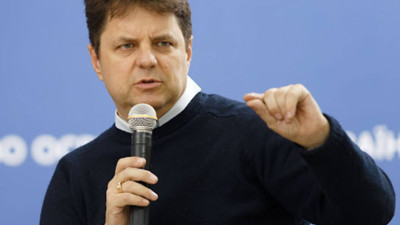
Mychailo Wynnyckyj. One of the things that we're doing as a ministry today is obviously dealing with the war, and the effects of the war, which are quite severe. We are confronted with school destructions and displacement of whole universities: massive dislodgment of students and faculty, both within the country and outside of the country. In addition to that, and in parallel, we are managing the day-to-day operations of a national education system, and in parallel, reforming higher education, which I'm responsible for. So it's a bit like trying to reengineer an airplane from turboprop into one with jet engines, while flying at maximum capacity 10,000 feet in the air. And having missiles shot at you at the same time.
Qant. Let’s start with academic research. How naturally has it connected to the war effort?
Mychailo Wynnyckyj. You must understand that I am not in a position today, for national security reasons, to talk about details. But I will tell you this much: were it not for Ukrainian universities, as technology centers, we would not have anti radar-equipment; we would not have long range drones; we would not have programmable systems for detonation, we would not be leaders in cyberdefense. And we would certainly not have anything that has to do with sea drones. All of those things were developed in one way or another in connection with Ukrainian universities. You see, everything that has been provided by our Western partners has been rocket based. Everything that has to do with drone technology, particularly long-range drones, has been basically developed in Ukraine.
Qant. In partnership with the Baltic states, isn’t it?
Mychailo Wynnyckyj. We have many collaborations with many different partners throughout the world. I think there is a very important point here. When we think of the military or, to use an American term, the military industrial complex, we normally think of something that is coordinated, from a central point, be it the Pentagon, be it Brussels, be it wherever. In Ukraine, technological innovation usually comes from the ground up. Individual brigades, individual battalions, will have their own individual, if you like, R&D centers. I'm not sure I even want to call them that, because very often they're based on practical search for solutions in the field, which are then shared.
Qant. R&D centers at the battalion level, really?
Mychailo Wynnyckyj. Absolutely. In Ukraine, grassroots innovation is scaled after testing, rather than being initiated from a central point via, for example, a government-based contract. Only after successful testing will a central coordinating body say: “Hey, this is something that is worth scaling beyond your battalion or your brigade.” Most of the technological innovation that has come out of this war, in the last two years anyway, has come out of battalions in cooperation with individual labs. And then been scaled up.
Qant. Is this bottom-up approach a conscious decision from the government? Perhaps in a sort of force majeure, under the pressure of events?
Mychailo Wynnyckyj. Not at all. It is just the way it is. As a sociologist, I would explain it as being, perhaps, a cultural characteristic. Part of the resilience of Ukrainians. After the invasion in 2022, I have been trying to explain to western audiences, in multiple interviews, why we are so resilient. In the summer of 2022, I came up with an analogy. I was sitting at my cottage looking at a beehive. A beehive cannot exist without a queen. You must have a queen in the hive or it will die. But the queen does not provide instructions to the bees. The bees do it on their own. And that's what Ukrainians are about. Ukrainians are bees.
Qant. You might be aware that swarm combat is a theory that has been talked about in the Pentagon for more than 20 years…
Mychailo Wynnyckyj. Indeed. The Western, particularly American, colonels and generals that I've spoken to, are all fascinated by the way in which Ukrainians have brought to reality the doctrine of small group tactics. NATO has talked about it for many, many years. But it's actually been very rarely used in a combat situation. The Ukrainian resistance is all about small group tactics. We are fighting a traditional opponent that has attacked us with a much larger army. We are a smaller country, with fewer resources, etc. Small group tactics and grassroots innovation have to do with what it means to be Ukrainian. This is how we are resilient and successful: how we build social capital. And that is where education comes into play.
Qant. How is that?
Mychailo Wynnyckyj. Ukrainians have proven themselves to be extraordinarily resilient. And this is a point of pride for us. When I was living through the initial months of the invasion - February, March, and into April of 2022, I was in Kyiv. My family went to our cottage, where multiple families came to us from the northern parts that were under occupation. So, our cottage turned out to have 22 people at one point living in it. But even at that darkest hour, no one was even considering that Kyiv could fall.
I'm a sociologist by training and I think this idea of mutual help and assistance comes from a very high degree of something called social capital. I remember very well, from my university days, John Helliwell and Robert Putnam’s Economic Growth and Social Capital in Italy. Immediately after the war, despite pre-existing differences between north and south, Italy was brought together. I think that we are witnessing something very similar in Ukraine. Be they from the East and South, that are directly confronted with war, or from the West, people are coming together in mutual help, social capital is being built despite unavoidable tensions. And that doesn't come from thin air! Nothing comes from nothing: you need an educational system. People are taught to help each other; solidarity and resilience is something that is taught in schools.
Qant. How very far from Western education systems this is… But doesn’t this come first from a shared national ordeal?
Mychailo Wynnyckyj. It's a bit of a chicken and egg argument. Obviously, you need to have a shared educational base, in order to have resilient reaction. The war situation strengthens the cultural ties that we feel bind each other. In other words, I think it's something that goes together.
I think we have a cultural legacy, which is in many ways positive and explains some of our resilience in the face of conflict. Some of that, ironically, comes from surviving the Soviet Union. Surviving in the Soviet Union and surviving the Soviet system. So, it wasn't positively reinforced. It was, in fact, negatively reinforced, but nevertheless, the results are what they are. I'm not going to say that it's all thanks to the educational system. Five or ten years ago, this system was universally seen as broken. We're trying to improve it, to westernize it somewhat. But I think one of the things that we have found is that not everything is bad.
Qant. How to manage it?
Mychailo Wynnyckyj. It's very important for us to exit this war a better country than we entered it. And when I say a better country, I mean, not just in terms of infrastructure, roads, bridges, buildings, etc., that have been destroyed and now need to be rebuilt. But also, in terms of human and social capital, which are developed through the educational system. And that obviously needs to be improved. Europeanized, if you like: the higher education system needs to become fully compatible with the European higher education area. We are very much on the right track for that.
In short, we need to take what is good in the European educational system without losing this distinctly Ukrainian core which is of very high quality. Sometimes I think that we may be in fact, moving a little bit too far to a European system sometimes, which is much more individualistic. I often think of phrase that I heard from a university dean once in Slovenia: ‘Take the best from the West and leave them the rest.”
Qant. What part does tech play into it?
Mychailo Wynnyckyj. We implement tech education in some way or other from grade one, throughout the whole school system. This has been strengthened, in fact, because prior to the invasion, we had Covid. We have been effectively in a distance learning education almost for the last four years. To be specific, there is no problem with any child in terms of IT literacy. None.
We also have been implementing English language education from first grade for the last 10 years. 95% of our students have some form of English language education from first grade. We have just adopted a law to strengthen the move towards English as a second language throughout the educational system, and also making English a requirement for civil servants, for degrees for many professional jobs, etc.
In our system, just as a point of fact, schools have bomb shelters, or we don't have students. Simple as that. And children are evacuated from schools into shelters at every warning. Error rates are relatively high. Warnings, sirens go off on basically a daily basis. Some of the adults have stopped taking air strike warnings very seriously. And obviously, we are concerned about that. In school, children are always evacuated to shelters and schooling interrupted. Always.
Qant. Which must make distance learning all the more beguiling…
Mychailo Wynnyckyj. It’s not quite that simple, but I'm amazed by the scalable innovations that have been done in terms of government interaction with things like Diia. The original 2020 Digital Education platform involved more than 6 million Ukrainians in the face of the pandemic and the invasion. Now Diia.Education is expanding to all skills and abilities relevant to the modern world in general.
We have something called the Unified education database, which is now not just a database, but actually an interactive tool for students and for institutions. What has happened over the last three, four years with distance education, and the digitalization of everything that has to do with the educational process in universities and high schools, in schooling in general, has been just amazing. So edtech technology, digitalization is something that I would say, Ukrainians have been quietly deploying previously. Now it's no longer “quietly”. It's now: “Hey, world, look at us. We're leaders”.
Qant. How long are you planning for the education system to remain on a war footing? And what will come next?
Mychailo Wynnyckyj. Aggression is woven into the very nature of the Russian Federation, in its DNA so to say, its political culture. The war will end when the Federation ends, and Russian people gain their own freedom. Indeed, only free Russians will allow Ukrainians to live in peace.
In the meantime we have the question of helping veterans back into civilian life, with a mix of therapy and training. But that will be the subject for another interview. Hopefully soon!
Jean Rognetta, in Kyiv, July 22nd 2024.